

Knee Pain
Do you have knee pain or soreness? Let us help you become pain-free and injury-free. We are highly specialized in treating knee pain and injuries related to the knee.


Physiotherapy for knee pain.
We are specialists in treating complex knee problems. We treat everything from runner's knee and jumper's knee to pain related to osteoarthritis and rehabilitation after surgery. A knee problem rarely starts in isolation in the knee itself. We therefore analyze your entire function, especially the interaction between your foot, hip and back, as imbalances here are often the real cause of the overload of the knee. By combining manual treatment with specific rehabilitation of the entire muscle chain, we ensure a durable solution that prevents future problems.
"The best physiotherapist."
Alfred L. B.
Lars is the best physiotherapist. Lars solved the problem with a different technique that I still have difficulty understanding. My knee injury turned out to be a problem with my hamstring.

Posted on Google.
"The pain disappeared."
Anne-Marie Maarbjerg
I had knee pain a few months ago. After 1 week the pain disappeared and I can now walk without knee pain. I can only recommend Copenhagen Physio.
Posted on Google.
"Extremely thorough."
Ditte Marie Lindberg
I can highly recommend Lars! It took 2 visits to fix a knee injury. Extremely thorough in his examination and spot on in terms of diagnosis and treatment. Big fan.
Posted on Google.

Pain on the inside of the knee
There may be several reasons why you have pain on the inside of your knee. It may be due to overloading of the three tendons that attach to the inside of your knee. The reason why they are overloaded is typically due to weak muscles around the pelvis, for example the gluteus maximus or the hip flexor. It is important to have the injury diagnosed correctly by a physiotherapist so that you get the right treatment. We are of course happy to help with this. Other injuries on the inside of your knee include meniscus damage (read further down) or rupture of the inner collateral ligament. With these injuries, it is about retraining the muscles around the knee and gradually increasing the load and difficulty of the exercises.
Pain on the outside of the knee
Runner's knee is the most common cause of pain on the outside of the knee. The pain is located where the large tendon attaches to the outside of the knee. The cause of the injury is typically due to weakness in the gluteus medius muscle. In some cases, it can also be due to weakness in the gluteus maximus muscle and hip flexor or reduced mobility around the pelvis. It is therefore important to have your knee, hip and pelvis properly examined before you begin your rehabilitation. Otherwise, there is a risk that you will train "incorrectly", which will have no effect or may even worsen the injury. The pain on the outside of the knee can also be due to an irritated bursa or an injury to the meniscus or collateral ligament.
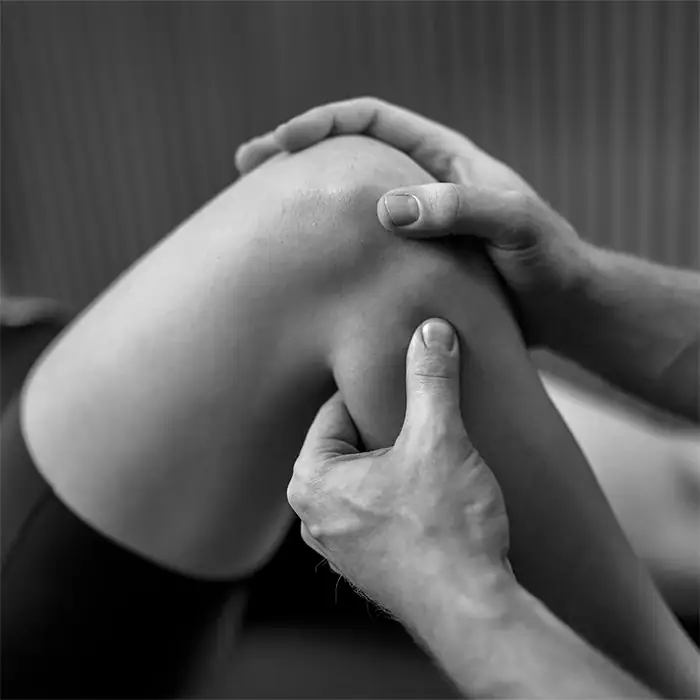

Pain in the back of the knee
There can be several reasons why you have pain on the back of the knee. Most often, it is due to an overload of the hamstring muscles (hamstring). Here it is important to identify why the hamstring has been overloaded. Is the hamstring weak or is it trying to compensate for other weak muscles? The muscles that have the same function as the hamstring are, for example, the calf muscle (bends the knee), the gluteal muscle (extends the hip) as well as the hip flexors and the rectus abdominis muscles (tilts the pelvis). If these muscles are weak, the hamstring will try to compensate, which is why it is being overloaded. Other causes of pain in the hamstring include meniscus damage and fluid in Baker's cyst.
"Lars is super skilled."
Lone Larsen
I have been suffering from osteoarthritis and knee pain for several years. It was a fantastic experience! Lars managed to eliminate my pain already on the first visit! Lars is super skilled and gets my warmest recommendations!
Posted on Google.
"My knee is much better."
Frederik Falk-Sørensen
I had been suffering from knee problems for a long time. Thomas was able to pinpoint immediately that the problem was in my hip and buttock. After two treatments, my knee is much better.
Posted on Google.
"Extremely competent."
Camilla Kjær
I have been treated by both Lars and Michael. I used to have pain in my knees and back. I have found both to be extremely competent and professional. The highest recommendations from here!
Posted on Google.

Anterior knee pain
Pain in the front of the knee is common and can be caused by several things. For example, it can be caused by jumper's knee, which is an overuse injury to the patellar tendon. This injury requires specific strength training to heal. However, it is important to investigate why this injury occurred in the first place. Osgood Schlatter appears in young athletes during their growing years and causes pain under the kneecap. Although the injury is related to growing years, we have great success in treating the injury and relieving the pain. Pain in the front of the knee can also be caused by patellofemoral syndrome. This pain can be treated by activating and strengthening the muscles around the knee and pelvis.
Pain when bending the knee
Some patients experience pain when bending the knee. This is most often due to something getting caught on the back of the knee. For example, the meniscus can be pinched when bending the knee, causing pain (read further below). Pain when bending the knee can also be caused by an inflamed popliteal tendon. When the tendon is inflamed, it can cause pain when it is pinched. The same applies if the bursa at the back of the knee joint is inflamed (Baker's cyst) or if there is swelling at the back of the knee as a result of surgery. In all of the above cases, it is about finding the underlying cause of the problem and ensuring that full strength is restored in the muscles around the knee and freedom of movement is achieved.
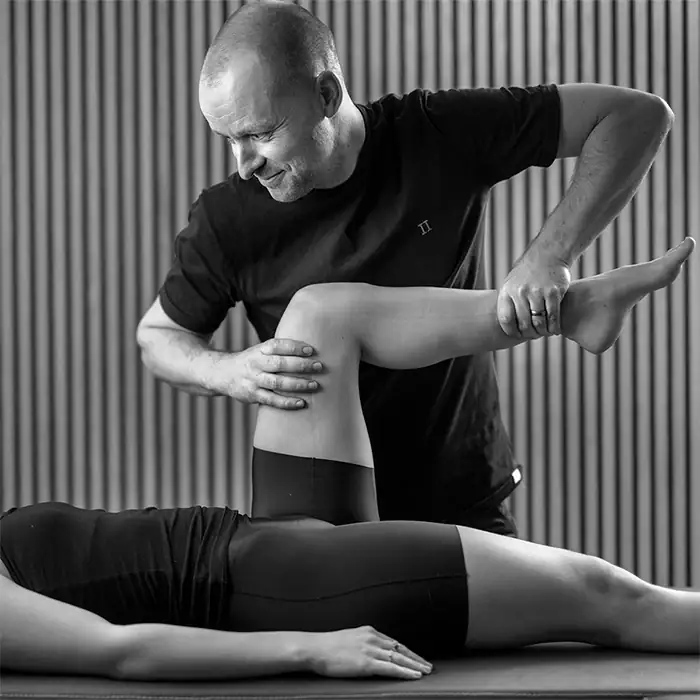

Anterior Cruciate Ligament
An ACL injury (anterior cruciate ligament) is a serious injury that can have major consequences for an athlete. The injury often occurs when the knee rotates while the foot is firmly on the ground. An ACL injury may require surgery if the anterior cruciate ligament is completely torn. However, this depends on age, function and ambition level. Rehabilitation after an ACL injury is long-term and sometimes complicated, which is why it requires expert guidance from a physiotherapist. In rehabilitation for an ACL injury, the focus is on strengthening the muscles around the knee and pelvis as well as balance training. It is particularly important to retrain the strength of the hamstring muscles, as they have the same function as the ACL.
Meniscus injury
Symptoms of a meniscus injury include a stabbing pain in the knee. Other symptoms may include locking, pain when rotating the knee, as well as swelling and clicking sounds. Most meniscus injuries are less serious and "heal" on their own. To optimize healing, it is important to retrain and ensure that the muscles around the knee are fully activated. It is also important to ensure that the hamstring muscles are not overstretched, as one muscle (semimembranosus) attaches to the inside of the meniscus. This can pull on the meniscus and worsen the pain. In more serious meniscus injuries, surgery may be necessary. The surgery must be followed up with rehabilitation under the guidance of a physiotherapist.
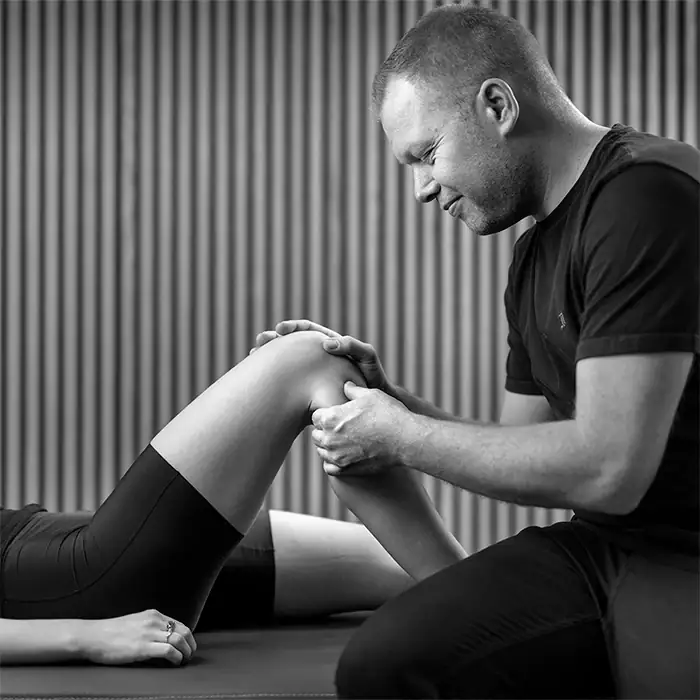

Osteoarthritis in the knee
Osteoarthritis in the knee is a natural age-related change. Everyone gets osteoarthritis if they get old enough. The classic symptoms of osteoarthritis of the knee are pain that worsens with stress. However, it is important to point out that osteoarthritis does not necessarily cause pain. 50% of all 70-year-olds have osteoarthritis, but not everyone experiences pain as a result. At the clinic, we experience that pain can be significantly reduced by activating and strengthening the muscles around the knee, hip and pelvis. We have a particular focus on restoring full strength in the front thigh, back thigh and buttocks. Of course, we cannot remove osteoarthritis in the knee, but we can ensure that the function of the knee is optimized and functions as well as possible. This can often reduce a large part of the pain.
Effective treatment of knee pain
Physiotherapy is incredibly effective in treating knee pain if done correctly. We find and treat the underlying cause of knee pain. We are thorough in our examination and do not just treat symptoms. We examine mobility and muscle strength around the ankle, knee, hip, pelvis and lower back, as all components can be responsible for knee pain. We always try to identify the underlying cause of your knee pain. For example, many people believe that pain on the front of the knee can be treated with exercises for the front thigh, as it seems straightforward. The fact is that the pain is far more often due to reduced strength in the hamstrings. It therefore makes no sense to focus on the front thigh if the actual problem is related to the back thigh.

Get a pain-free knee
Our physiotherapists are specialized in treating knee pain and knee injuries. You can book an appointment via the orange button below or by calling our secretary on tel. +45 60 55 44 50.
Address
Copenhagen Physio
Vesterbrogade 37, 2. tv.
1620 København V
Metro / Train stops 200 m. from the clinic (Central Station / Vesterport).
Parking by car: Saga P-hus is located 100 m. from the clinic.